
How AI Agents Help Small Service Businesses Win More Jobs
What AI employees actually do for a service business, and how one operating system ties calls, follow-up, scheduling, invoicing and reporting together.
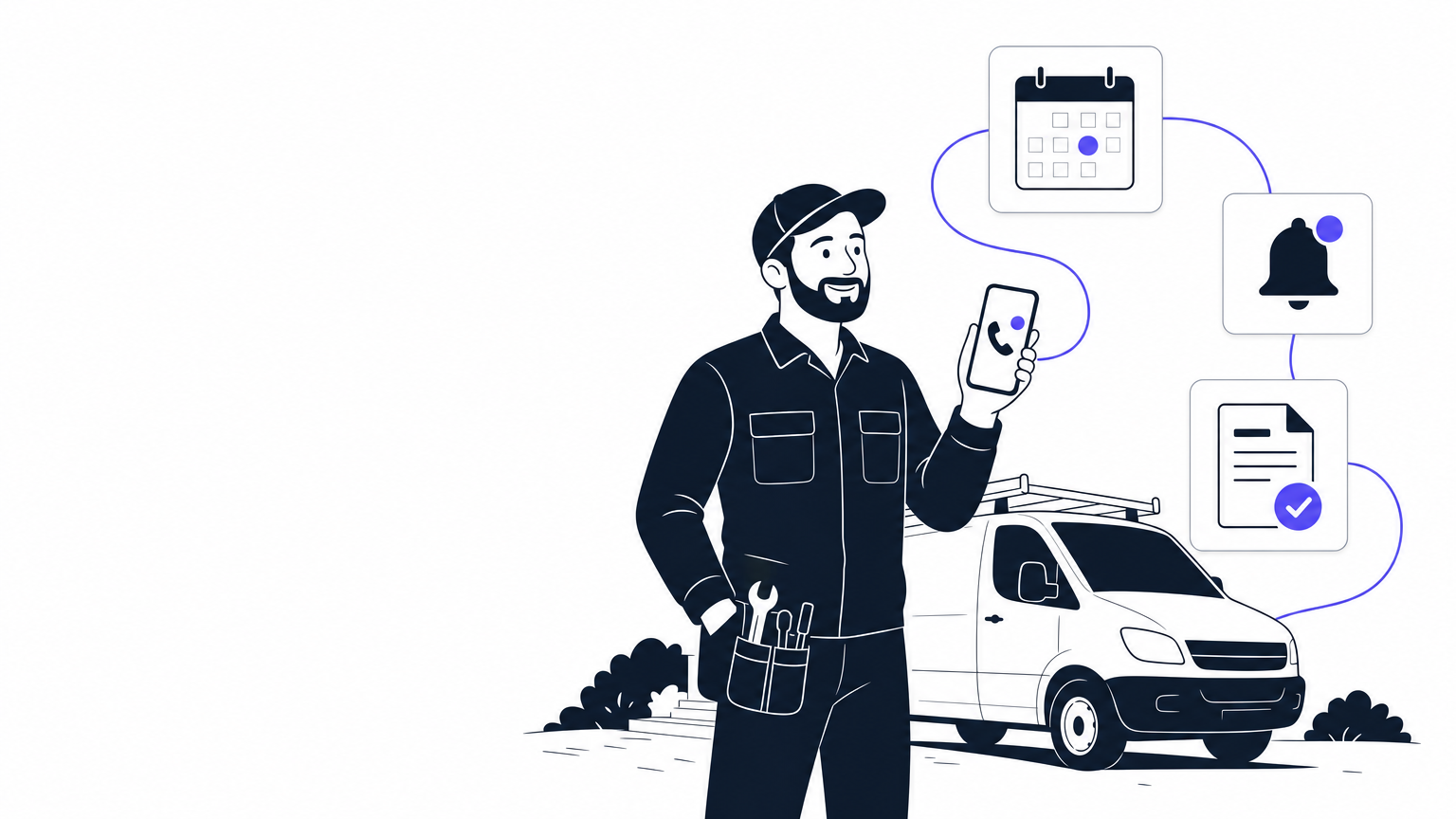
AI agents answer calls, follow up on leads, schedule work, and keep paperwork moving without adding headcount. For an owner running a small service business, the gap between winning a job and losing one usually shows up in the same places: who answered the phone, who replied to the lead, and who sent the invoice.
This post covers what AI agents actually do for a service business, and how a business operating system ties the pieces together. No invented numbers. Just the parts, in the order most owners run into them.
Where the jobs disappear
A service business rarely loses a job at the price conversation. It loses it earlier.
The phone rings while the crew is on a roof. Nobody picks up, the caller does not leave a message, and they dial the next listing. Someone fills out your form at 9pm. A reply goes out the next afternoon; by then the job is booked with whoever answered at 9:04. An estimate goes out and the follow-up never comes, so the homeowner keeps shopping. One invoice gets set aside after the job, the reminder never goes out, and the payment keeps waiting.
None of this shows up on a profit and loss statement until months later, when revenue looks flat and nobody can explain why. The Hidden Cost of Slow Response walks through that pattern in detail.
Independent research supports how fast that decay happens. In a study of 1.25 million online sales leads, contacting a prospect within an hour was associated with nearly seven times the likelihood of qualifying the lead compared with waiting at least another hour (Harvard Business Review, 2011). The study measured online inquiries rather than phone calls, but the underlying pattern is the same: interest decays while a customer waits.
CampaignAI starts on the other side of it. Find where the response is escaping, then put an AI employee on that job.
The four AI employees
CampaignAI builds AI employees, each handling one job end to end. People stay in charge of judgment calls, pricing, and anything unusual. The AI hands off to a human whenever it should.
The AI receptionist
It answers calls, texts, and website chat around the clock. It answers common questions, captures what the caller needs, books appointments, and hands anything unusual to your team with the context attached. The goal is simple: recover more missed-call opportunities instead of a hang-up with no record.
The AI scheduling assistant
It keeps the calendar current. Booked appointments get confirmations and reminders, and reschedules get handled without a round of phone tag. A no-show costs more than the hour on the calendar. It also costs the drive time and the rest of the crew's day.
The AI sales and follow-up agent
It replies to new inquiries in minutes, qualifies them, and keeps the follow-ups going until they book or say no. Reply speed matters when a caller is shopping several businesses at once, and a follow-up agent never forgets the second and third contact.
The AI bookkeeping assistant
It keeps invoices, receipts, and payment follow-ups moving so you are not chasing paperwork after hours. Winning the job and getting paid are two separate jobs, and the second one is where the day quietly disappears.
Each employee can run on its own. Most owners start with the one that plugs their worst leak.
One operating system, not five disconnected tools
A stack of disconnected tools creates its own problem. Leads sit in one place, appointments in another, and no one can say which ad or listing produced which job.
CampaignAI builds a business operating system around each business type. One intake layer takes in calls, forms, chat, social messages, QR codes, and imported contacts. AI response, scheduling, follow-up, invoicing, and reporting all run on the same customer record, so the question "where did this job come from" has a real answer.
That is the difference between software and a system. Software waits for someone to drive it. A system keeps moving when the owner is on a job site.
What this changes for an owner-operator
Owner-run service businesses share a pattern: the owner is the salesperson, the dispatcher, and the bookkeeper at the same time. Every hour spent chasing paperwork is an hour not spent on jobs or estimates.
AI agents change that math in one specific way. They handle routine work the same way on day 200 as on day one, including nights, weekends, and lunch breaks. People stay in charge of judgment calls, pricing, and anything unusual.
If you have tried a CRM alone and the leaks are still there, Beyond the CRM explains why software by itself rarely fixes response time.
Start with a demo, not a purchase order
CampaignAI starts with a free 30-minute demo with John Boladian. The demo walks through which AI employees fit your business, what each one would handle, and what setup involves.
Start with the workflow that needs the most attention. During a demo, we can explain the right setup, what is included, and any applicable subscription or usage charges before you commit. You can also explore the available options on our pricing page.
If the phone is your worst leak, start there. If estimates keep stalling, start with follow-up. The demo covers it either way.